


D8073 Concerns: A Test That Doesn’t Measure What It Claims
 Standard & Regulations
 PAC Powered by Emcee
Field data, bench data, and D8073’s own published numbers all show the same gap — and why that gap is a flight-safety issue, not a paperwork one.
Bottom Line: The Flight-Safety Issue
Filter-separators exist to strip free water out of jet fuel before it reaches an aircraft — water left in fuel can freeze and restrict fuel flow, feed microbial (“bug”) growth that fouls filters, and corrode tanks and fuel system components. D8073 is supposed to confirm a fuel will release that water. Independent field data, independent bench data, and the manufacturer’s own validation numbers all show it routinely reports a “pass” on fuel that D3948 and D7224 — and real filter-separator behavior — show has lost that ability.
That’s because D8073 isn’t measuring water separation at all; it’s reading the glow of a dye. A test that reliably misses degraded water separation isn’t a paperwork problem. It’s a flight-safety risk.
Two Different Tests. Only One of Them Separates Water.
For 60+ years the Micro-Separometer (D3948/D7224) has been the field-proven standard: it physically forces a water/fuel emulsion through real fiberglass coalescing media — the same class of material used in an aircraft filter-separator — and measures how much water actually got through. A competitor technology provider and instrument manufacturer are now promoting D8073 as an alternative, but it works on a different principle entirely: it mixes fuel, water, and a fluorescent dye with a small ultrasonic wand, then compares the dye’s glow before and after part of the sample passes through a small disposable cartridge. Independent teardown found that cartridge to be dye-treated paper in a plastic housing — not coalescing media, and not tested to any aircraft filter-separator qualification standard, despite “5th-Edition API filter media” marketing claims. No water is ever physically separated in the D8073 procedure — the result is purely optical, and the dye itself responds strongly to only one class of surfactant (see supporting documentation)
Precision is Not Accuracy
D8073 does have tight repeatability and reproducibility — ASTM’s own multi-lab study backs that up. But precision only measures whether a test agrees with itself; accuracy measures whether it agrees with reality. D8073’s own standard concedes the difference: it states the method “has no bias” only because “the value of WSI is defined only in terms of this test method” (D8073 §14.4) — a self-referential definition that can’t be “wrong,” no matter what the fuel actually does. The data below shows exactly that gap in practice
How a Near-Null Difference Still Produces a Number
D8073’s reading comes from comparing two small streams pulled from the same sample: one bypasses the cartridge (the reference), one passes through it. A wand sonicator only agitates a few millimeters around
its tip, so the two streams aren’t guaranteed to start from an evenly mixed sample. Both fluorescence readings then run through an undisclosed, proprietary algorithm (the standard names it only “algorithm Version 1.0”) and are converted to a score calibrated against known AOT concentrations. When a surfactant barely changes the dye’s fluorescence — as several approved additives and microbial contamination do — the two streams read nearly identical, and that near-null difference still comes out the other end as a confident-looking number, reported to the nearest 0.1.
What the Field Data Shows
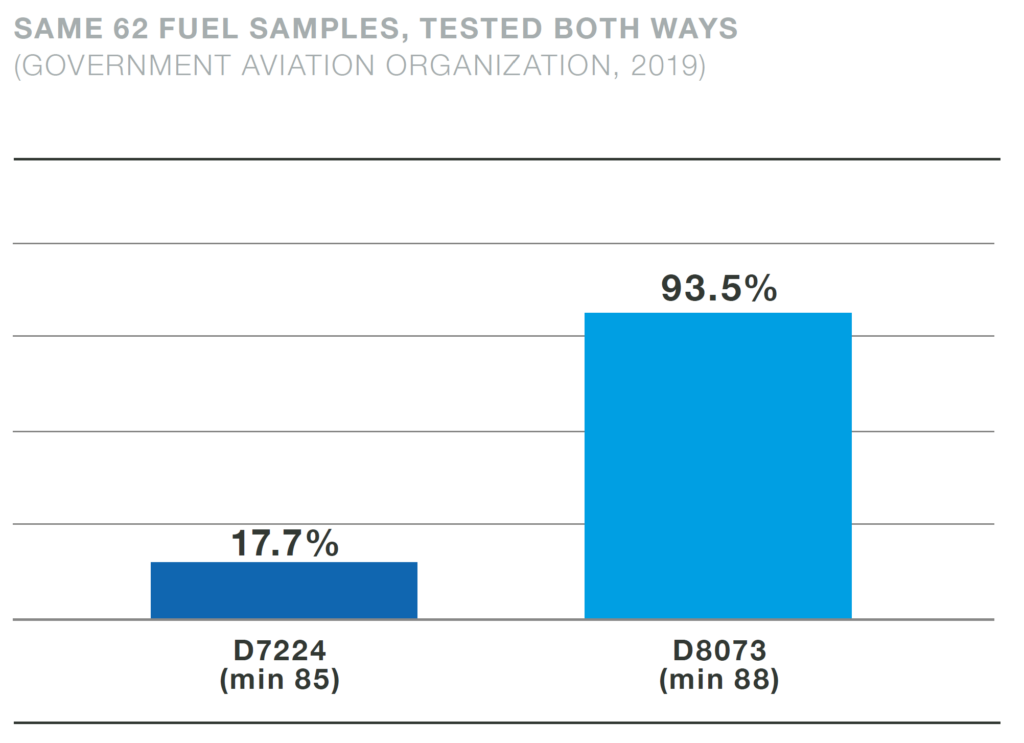
One outside laboratory ran D8073 and D7224 side by side on 62 real fuel samples (2019). Using each method’s own pass threshold, D8073 passed 93.5% of samples; D7224 passed only 17.7% of the identical fuel. One Jet A-1 sample scored 0 on D7224 — complete failure to release water — and 75.2 on D8073, on the same fuel.
What the Bench Data Shows
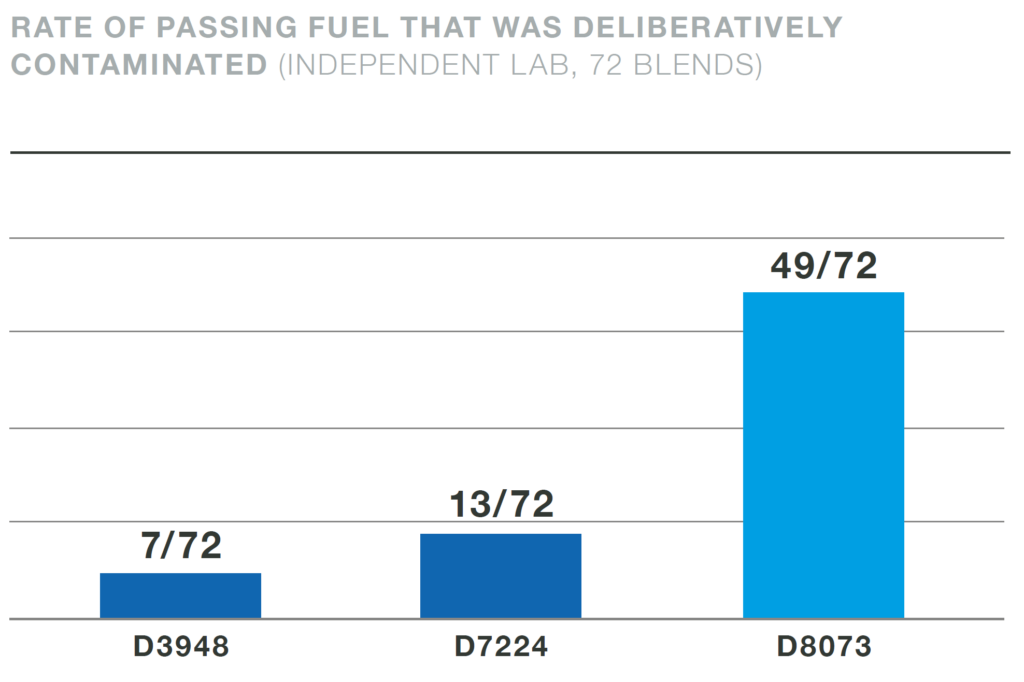
A second independent lab deliberately contaminated clean jet fuel (96–100 on all three methods) with a range of surfactants, then re-tested all three methods (72 blends). D8073 false-passed contaminated fuel 68% of the time (49/72) — versus 18% for D7224 and 10% for D3948 — and never once registered a false fail. That’s not caution; it’s insensitivity.
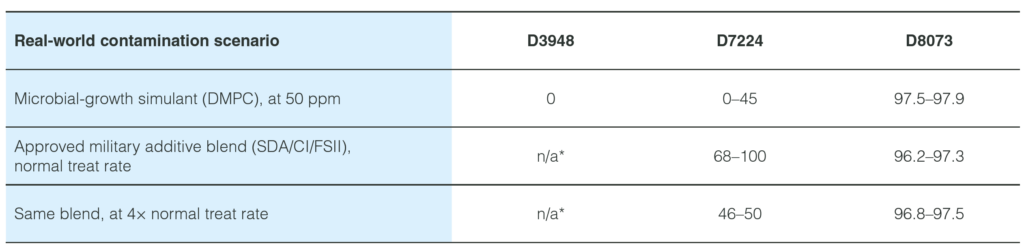
DMPC is a phospholipid — the same building block found in microbial cell membranes — so labs use it to simulate the surfactant film that bacterial/fungal growth leaves at the fuel-water interface, a well-documented real contamination problem, without culturing live organisms. At 50 ppm, D3948 and D7224 both show the fuel has essentially lost its ability to separate water; D8073 reads it as ~98. (*D3948 isn’t designed for additized fuel, so it’s left out of the blend rows.) This directly contradicts the competitor technology provider’s stated defense that D8073 intentionally ignores “weak” surfactants like SDA because they don’t affect water separation — the data shows they do. A validation report based on data from several additional independent labs adds more: several approved additives need 6×–100×+ normal treat rate before D8073 shows any real decline.
What This Means for Your Lab
A passing D8073 result is not confirmation that a fuel will separate water in an actual filter-separator, particularly for fuel with common approved additives, microbial contamination, or biodiesel cross-contamination, exactly where the data above shows D8073 missing real problems. D3948 and D7224 remain tied to real coalescing performance and should be the method of record whenever water separation is in question.
View the Full Data, Citations, and Technical Detail for this White Paper ⟶


